FIFA LED stadium light smart system supplier in Bolivia


Quick Answer: Baseball and softball fields may use similar lighting principles, but they should not share a copied fixture schedule. Field dimensions, outfield depth, pole setbacks, level of play and broadcast requirements change the illuminated area, optics, fixture count and civil work. Softball can be less expensive on a smaller site, but the final cost depends on the approved performance criteria and existing infrastructure.
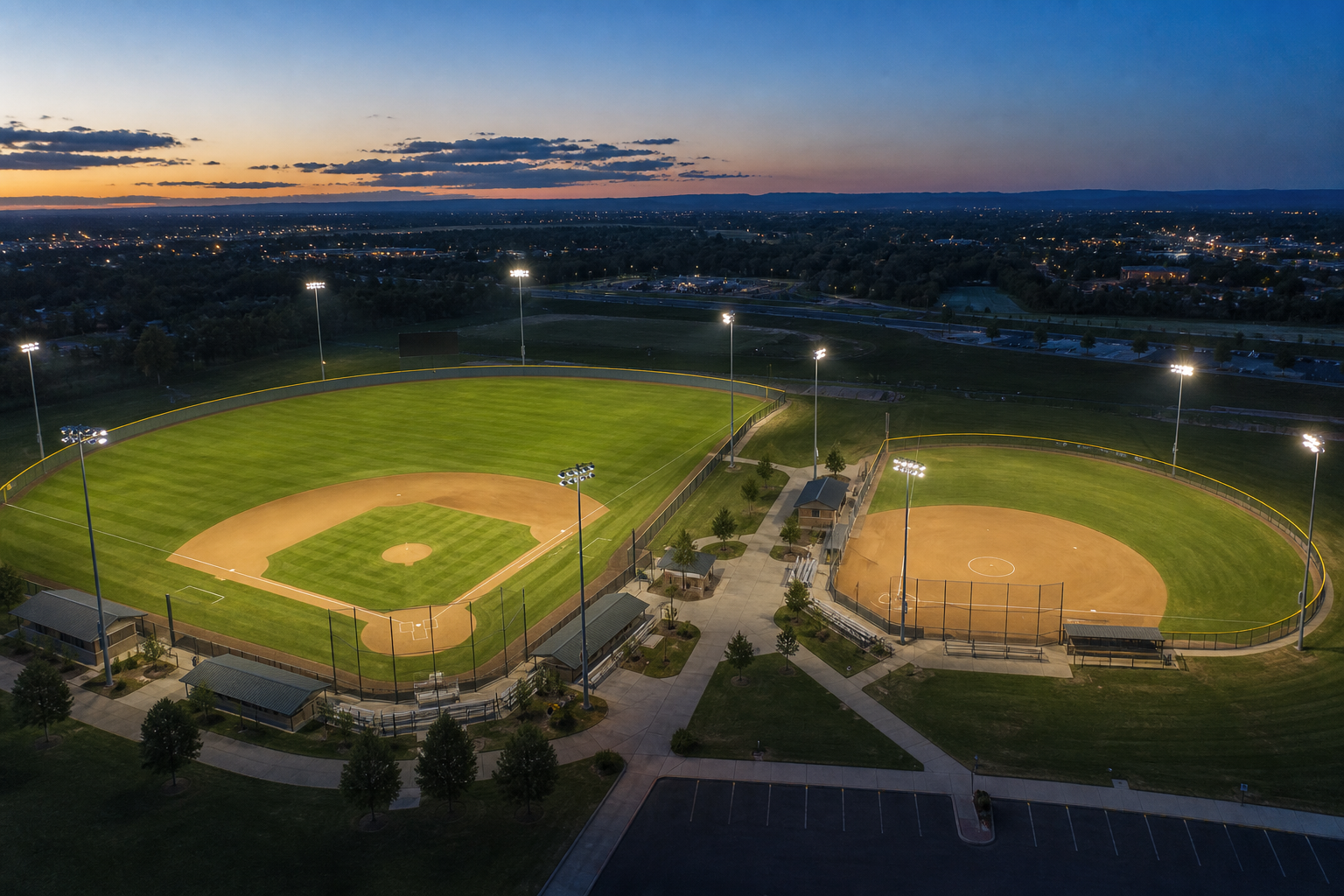
Both sports require players to follow a small, fast ball through the infield, outfield and air. The designer must control dark zones, glare and dirt/grass transitions. A larger baseball outfield can require longer throws or more aiming positions, while compact softball geometry may place luminaires closer to player sightlines.
This guide compares baseball field lighting cost and softball lighting design for project owners, EPC contractors and distributors. It provides a decision framework without inventing a universal price or fixture quantity.
Never estimate from the sport name alone. Use the survey and governing rules. Little League field specifications show that some youth baseball and softball divisions use 60-foot base paths, while older baseball divisions can use larger diamonds. Other leagues use their own dimensions.
| Geometry Item | Baseball Design Effect | Softball Design Effect |
|---|---|---|
| Base paths and infield | May increase with age or competition level | Often more compact, but verify the governing division. |
| Outfield depth | Can require longer optical throws and more illuminated area | Often shorter, bringing poles and boundaries closer to play. |
| Foul territory | Varies widely by venue and seating layout | Can be compact but remains part of the calculation grid. |
| Backstop and spectator zones | May create obstructions and glare-control constraints | Closer geometry can increase direct luminaire visibility. |
| Existing poles | Longer reach may expose inadequate height or optics | Old positions may still create shadows or poor uniformity. |
The owner must identify recreation, training, competition or broadcast use and obtain the applicable criteria. The Little League Lighting Standards and Safety Audit provides one published reference with infield/outfield targets, uniformity and rate-of-change requirements.
The RFQ should state:
average maintained horizontal illuminance for infield and outfield;
minimum illuminance and required uniformity ratio;
vertical illuminance where ball flight, spectators or cameras require it;
glare, spill-light, color quality and flicker criteria;
calculation grid, maintenance factor and field-measurement method.
Fields at the same competition level may use similar targets. The illuminated area—not the sport name—then becomes a major cost driver.
| Playing Zone | What Players Need to See | Lighting Check |
|---|---|---|
| Home plate and batter’s box | Pitch, bat, bases and close player movement | Direct glare toward batter, catcher and umpire. |
| Infield | Fast ground balls and short throws | Uniformity, player shadows and dirt/grass transition. |
| Outfield | Fly balls, long throws and boundary play | Vertical visibility, dark gaps and long optical throws. |
| Foul territory | Catchable balls and safe movement | Include the complete playable zone in the grid. |
| Spectator and camera views | Ball and player visibility from different directions | Vertical light, color, flicker and luminaire brightness. |
A deeper outfield may need narrower optics or more pole positions. Shorter throws do not automatically reduce glare. Test the arrangement from players, spectators and nearby properties.
Four-, six- and eight-pole layouts are options, not fixed rules. Fewer poles can reduce foundations but create longer throws. More poles provide aiming positions but increase structural and electrical scope.
Review each candidate location for:
required safety offsets and protection from ball impact;
player sightlines and direct glare;
fixture weight, projected wind area and headframe capacity;
foundation, soil, drainage and underground services;
maintenance access and lifting-equipment position;
property boundaries, roads, residences and curfew requirements.
A structural engineer should approve poles and foundations. The lighting calculation should use the exact mounting height, bracket geometry, optic and aiming point—not a generic symbol.
A lumen method can screen quotations before detailed photometric work:
Estimated fixtures = target lux × calculation area ÷ (lumens per fixture × coefficient of utilization × maintenance factor)
Consider two hypothetical fields at the same 400-lux planning target. Assume 200,000 initial lumens per fixture, a utilization coefficient of 0.55 and a maintenance factor of 0.80.
| Example | Assumed Area | Screening Result |
|---|---|---|
| Larger baseball field | 12,000 m² | 12,000 × 400 ÷ (200,000 × 0.55 × 0.80) ≈ 55 fixtures |
| Compact softball field | 8,000 m² | 8,000 × 400 ÷ (200,000 × 0.55 × 0.80) ≈ 37 fixtures |
These are hypothetical screening numbers, not recommendations. Actual quantity changes with infield/outfield targets, pole geometry, optics, vertical-light needs, glare and spill limits. Use the softball field lighting design guide for the full process.
| Cost Driver | Why It Changes the Budget |
|---|---|
| Illuminated area and target level | Changes the lumen requirement and fixture count. |
| Pole quantity and height | Changes foundations, steel, headframes, lifting and wiring. |
| Existing infrastructure | Service capacity, poles and underground cable may need replacement. |
| Optics and glare control | Additional aiming positions, visors or custom distributions may be required. |
| Controls and broadcast | Dimming, scenes, flicker performance and camera criteria add scope. |
| Site and approvals | Wind, soil, corrosion, permits, curfew and spill-light limits affect design. |
| Commissioning | Aiming, field measurement, correction and training require time and access. |
Installed cost includes luminaires, controls, poles, foundations, electrical work, design, permits, installation, aiming, testing and spares. Do not compare only fixture price. Review baseball and softball field LED lights as a starting point, then request a project quotation.
Calculate annual energy from the approved fixture schedule:
Annual energy (kWh) = fixture quantity × input watts × annual operating hours ÷ 1,000
Add control scenes instead of assuming every fixture operates at full output. Lifecycle analysis should include driver or module replacement, surge damage risk, cleaning, aiming checks, lift rental and spare-part availability. A lower installed wattage is valuable only if the maintained lighting criteria are still achieved.
Scaled field plan with actual playable and spectator areas.
Governing division, performance level and approval authority.
Existing/proposed pole coordinates, heights and structural information.
Infield/outfield targets, uniformity, glare, spill and camera criteria.
Electrical supply, controls, operating hours and curfew.
Model-specific datasheets, IES files, test reports and warranty process.
The broader sports lighting design guide explains the project inputs that should appear in a DIALux proposal.
No. Baseball often has a larger illuminated area, but cost also depends on performance level, poles, electrical work, controls, site conditions and existing infrastructure.
Possibly, if the product offers suitable optics and performance. The quantity, beam mix and aiming schedule must still be designed separately for each field.
The visual tasks and playing intensity differ, and the transition between zones must remain controlled. Separate grids make dark areas and gradients visible.
Only after structural and electrical review. Confirm condition, foundation, headframe, mounting height, wind load and whether the positions can meet glare and uniformity criteria.
Normalize the same lighting targets, fixtures, poles, controls, documentation, installation, commissioning, warranty and delivery scope before comparing price.
A scaled site plan with actual dimensions and pole information, combined with the governing lighting requirements and site-boundary constraints.
Send the field drawing, level of play, pole data, lighting criteria, electrical supply and site conditions. Hishine can prepare a model-specific fixture schedule and photometric proposal.
Author 2024-08-06
LED technology itself is not automatically harmful to children’s eyes. This guide explains the differences between permanent eye damage, temporary visual discomfort and sleep disruption, while showing...
Author 2026-07-29
All-in-one and split solar street lights each offer different advantages. This guide compares their system structure, installation, solar panel flexibility, battery capacity, maintenance, cost, and su...